




Advantages of 3D Animation for Manufacturing Companies
Introduction: Breaking Through the Steel Wall
Imagine standing in front of a multi-million-dollar industrial compressor or a next-generation CNC milling center. To the naked eye—and to a standard camera lens—it often looks like a massive, impenetrable steel box. While the external scale might be impressive, the true value of the machine, the proprietary engineering, and the cutting-edge technology are all hidden inside, buried beneath layers of heavy metal.
How do you effectively sell, explain, or train your workforce on a machine when they cannot actually see how it works?
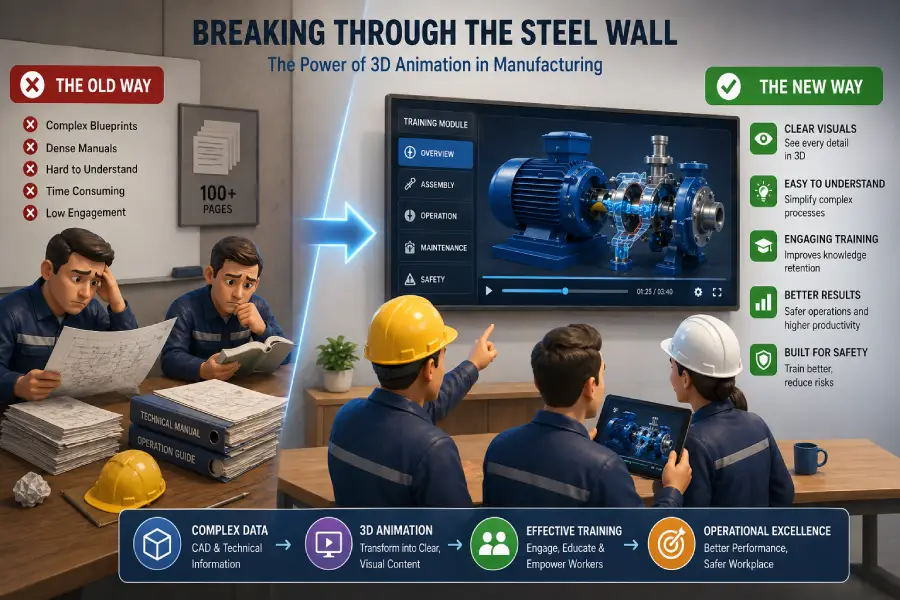
For decades, the heavy engineering sector relied on complex 2D blueprints, dense technical manuals, and lengthy PowerPoint presentations to bridge this gap. However, in today’s fast-paced, highly digitized global marketplace, asking an investor, a B2B procurement manager, or a new factory worker to decipher a 100-page schematic is a guaranteed way to lose their attention—and their business.
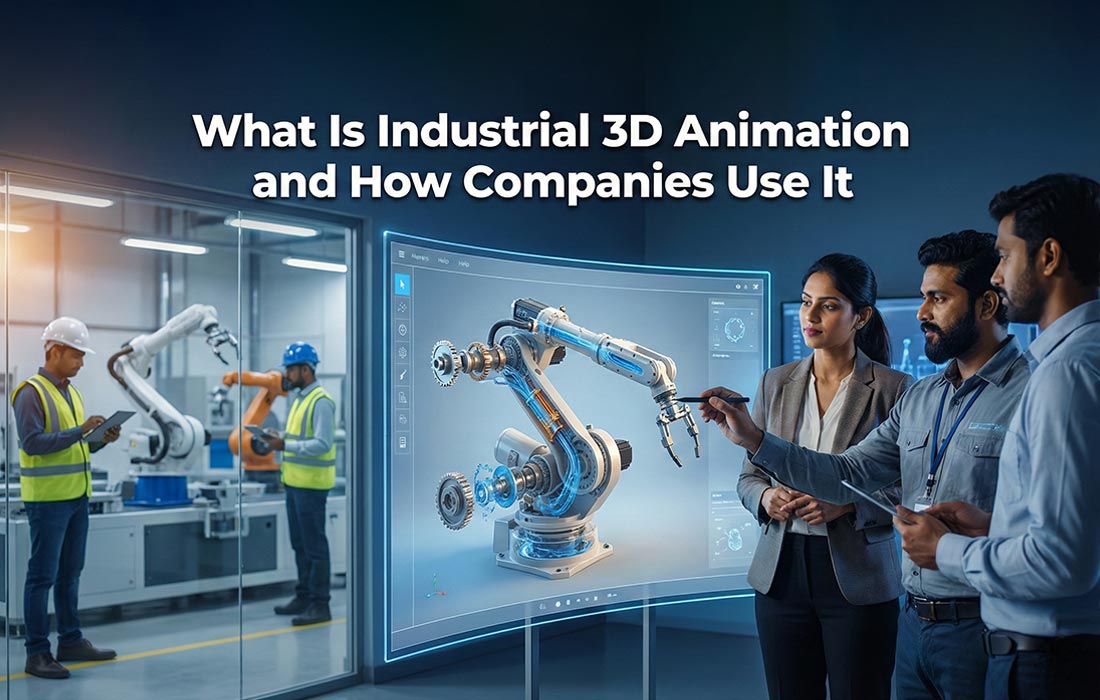
This is where the transformative power of digital visualization comes into play. Understanding the advantages of 3D animation for manufacturing companies is no longer just a marketing luxury; it is a critical operational necessity. By transforming CAD (Computer-Aided Design) data into hyper-realistic, dynamic video content, industrial brands can completely bypass the physical limitations of the real world.
At Pixverse Media Pvt. Ltd., we operate as Video Engineers, dedicated to bridging the gap between complex industrial technology and clear, compelling visual narratives. In this comprehensive guide, we will explore the profound engineering animation benefits, demonstrating exactly how industrial 3D visualization accelerates sales, enhances safety, and drives operational excellence.
1. Visualizing the Impossible: The “X-Ray” Advantage
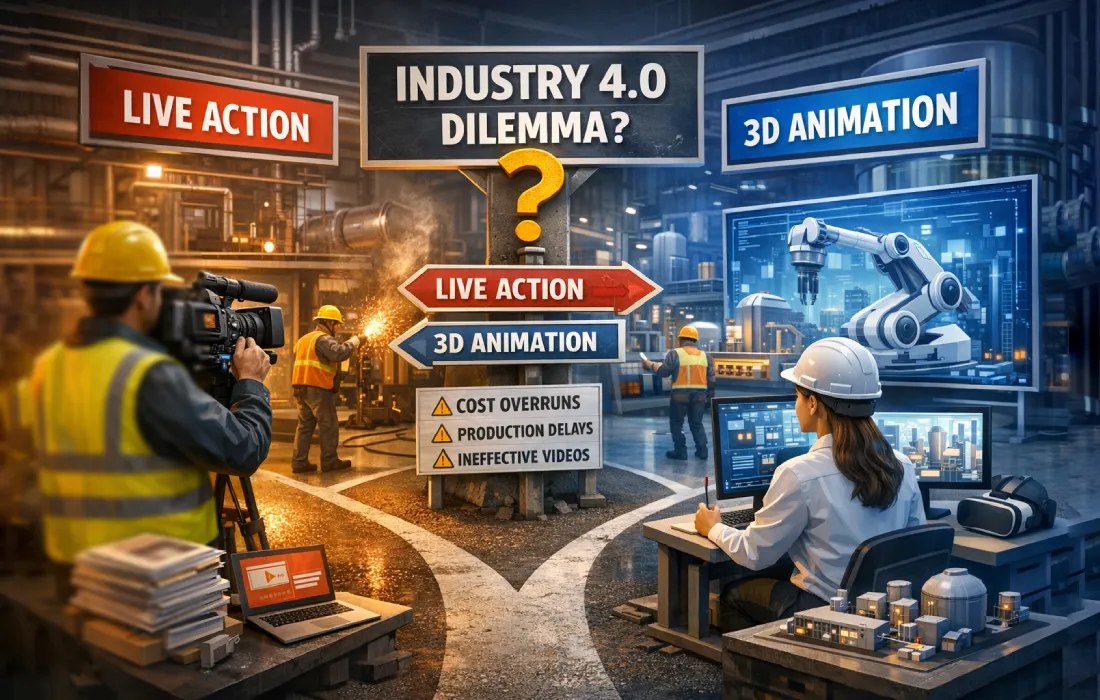
The single greatest limitation of traditional live-action videography is that it is bound by the laws of physics. A camera can only record the surface of an object. In the manufacturing sector, however, the surface is rarely the selling point.
Peering Inside the Machine
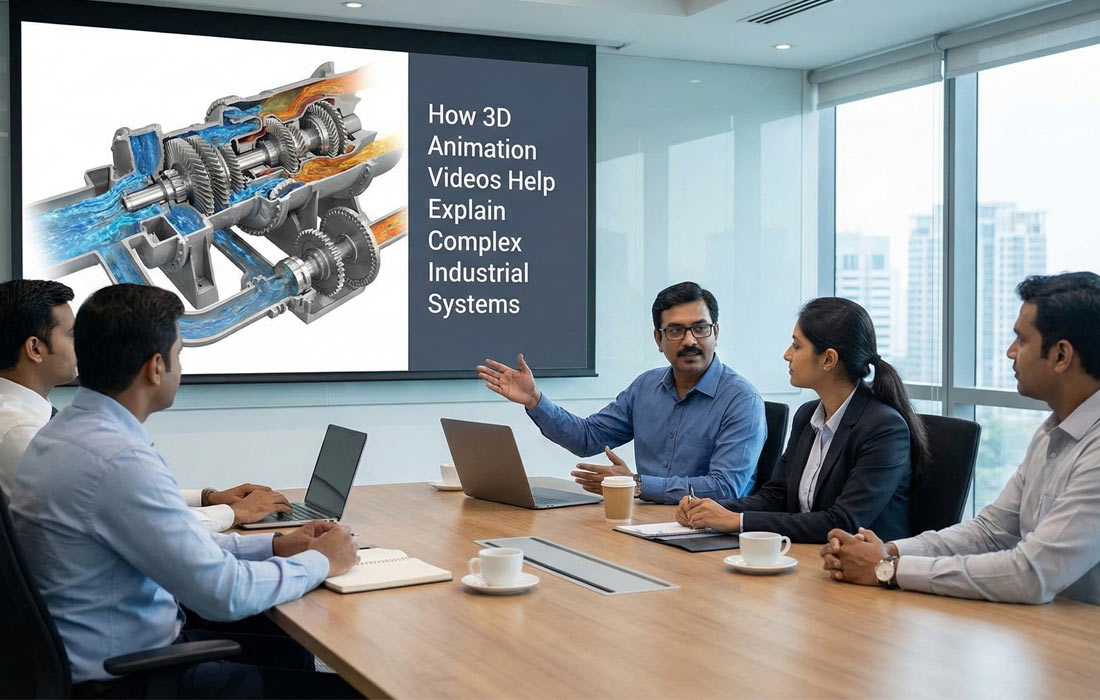
One of the most powerful technical animation advantages is the ability to grant your audience “X-ray vision.” Through advanced CGI (Computer-Generated Imagery), animators can seamlessly strip away the heavy steel casing of your machinery to reveal the internal mechanics in motion.
- Fluid Dynamics and Airflow: Whether you are selling an industrial HVAC system or a heavy-duty hydraulic pump, animation allows you to visually map the flow of air, water, or oil. You can use glowing, color-coded particle effects to show temperature changes, pressure buildup, or chemical reactions that are entirely invisible in the real world.
- Complex Gear and Motor Functions: A flawless machinery demonstration requires showing exactly how internal gears, pistons, and rotors interact at high speeds. Animation slows this down and isolates the specific components, making the invisible perfectly visible.
This capability transforms abstract engineering concepts into undeniable visual truths. When a B2B buyer can actually see your proprietary internal technology working flawlessly, their trust in your product skyrockets.
2. Marketing and Selling Before Manufacturing (Prototyping)
In the heavy engineering and B2B sectors, developing a physical prototype of a new machine or a large-scale architectural facility costs millions of dollars and takes months, if not years, to build. Historically, companies had to wait until this physical prototype was finished before they could start marketing it or securing pre-orders.
The Power of the Digital Twin
With the strategic manufacturing animation use, you no longer have to wait for the physical world to catch up with your engineering.
By taking your engineers’ raw CAD files, a 3D animation studio can build a hyper-realistic “digital twin” of your product. This digital twin looks, moves, and functions exactly like the real machine will.
- Securing Investor Funding: Before a single piece of steel is cut, you can deploy breathtaking product visualization videos to investors and stakeholders. Showing them a cinematic, fully realized animation of the future facility or product drastically increases the likelihood of securing capital.
- Pre-Selling to Global Markets: Your sales team can take an interactive 3D model or a polished animation to international trade shows. They can demonstrate the full capabilities of a machine that is still technically in the research and development phase, allowing you to generate revenue and pre-orders months ahead of your traditional schedule.
This accelerates your time-to-market and turns your engineering data directly into a revenue-generating asset.
3. Perfecting Design Communication and Eliminating Errors
Miscommunication during the engineering and design phase is incredibly expensive. When multiple teams—from mechanical engineers and electrical technicians to the marketing department and the end-client—are trying to interpret the same 2D schematic, errors are inevitable. A structural flaw that is missed on paper becomes a catastrophic financial loss when it is discovered during physical assembly.

Creating a Universal Visual Language
A core benefit of industrial 3D visualization is that it establishes absolute engineering clarity.
When you convert a complex blueprint into a 3D animated model, there is no room for misinterpretation. Everyone in the boardroom, regardless of their technical background, immediately understands the scale, the layout, and the functionality of the design.
- Stakeholder Alignment: During project pitches, design communication is streamlined. If a client wants to see how a different configuration of a robotic assembly line would look, that change can be made digitally and visualized instantly, ensuring complete alignment before physical manufacturing begins.
- Identifying Spatial Clashes: Animation allows engineers to run digital simulations of the assembly process. They can visually identify if two moving parts will clash, or if a maintenance hatch is physically inaccessible to a human worker, solving the problem in the digital realm where fixes cost pennies, rather than on the factory floor where fixes cost thousands.
4. Revolutionizing Safety and Operational Training
A factory floor is an inherently dangerous ecosystem. Heavy moving parts, high-voltage electricity, and toxic chemicals pose constant threats. As we established in previous guides, traditional safety training often fails because relying on text-heavy manuals does not trigger the spatial awareness required to survive an emergency.
Risk-Free Consequence Simulation
You cannot safely use live-action video to demonstrate a catastrophic accident. You cannot ask a worker to bypass a safety guard and crush their hand, nor can you intentionally start a fire to film an evacuation video.
The advantages of 3D animation for manufacturing companies shine brilliantly in the realm of safety training.
- Simulating the Worst-Case Scenario: Animation allows you to build a hyper-realistic digital replica of your factory floor and safely simulate catastrophic failures. By showing a 3D animated worker failing to follow Lockout/Tagout (LOTO) procedures and visually simulating the resulting electrical arc flash, you trigger a deep, emotional response in the viewer.
- Hyper-Focused SOPs: When teaching highly technical Standard Operating Procedures (SOPs), live-action video is often cluttered with distracting background noise. Animation allows you to place the specific machine in a clean, bright digital void, focusing the trainee’s eye entirely on the precise dials and levers they need to operate.
This visual shock value and clarity shift the workforce from passive compliance to active hazard respect, drastically reducing workplace incidents.
- Overcoming the Global Language Barrier
The manufacturing supply chain is a massive, interconnected global network. A B2B company based in Gujarat might be selling heavy machinery to a client in Germany, sourcing parts from Japan, and employing a diverse, multilingual workforce on its own shop floor.
Relying on text-heavy presentations or live-action videos that require awkward voiceover dubbing often leads to miscommunication.
Visuals Transcend Language
High-quality product visualization videos and 3D technical animations rely on visual truth, not complex dialogue.
- Universal Understanding: When you show an animation of a complex grinding circuit being dismantled step-by-step, an engineer in Tokyo understands it just as perfectly as an engineer in Mumbai. The visual mechanics speak for themselves.
- Flawless Localization: Because 3D industrial animations rarely feature human characters speaking directly to the camera (requiring complex lip-syncing), translating the content is incredibly easy. A single 3D animated SOP video can be perfectly dubbed into Hindi, English, German, and Mandarin at a fraction of the cost of reshooting a live-action video.
- Long-Term Cost-Effectiveness and Unmatched Scalability
When evaluating the ROI of marketing and training assets, procurement managers must look at the long-term lifespan of the content.
If you spend a large budget filming a live-action video of your factory floor, that video is locked in time. If you upgrade a single CNC machine six months later, or if a regulatory body mandates a new type of safety helmet, your live-action video is instantly obsolete. Fixing it requires hiring a film crew, halting your production line, and reshooting the footage.
The Infinite Updatability of Digital Assets
This is perhaps the most lucrative of all the engineering animation benefits: unparalleled scalability.
3D animation is built entirely using digital assets. If your machine design changes, or if your safety protocols are updated, our animators simply open the existing project file, swap out the digital 3D model, and re-render the video.
- Zero Operational Disruption: Creating and updating animations requires zero camera crews on your active factory floor. Your production quotas remain completely uninterrupted.
- A Living Asset Library: This digital flexibility ensures that your visual marketing and training library can evolve seamlessly alongside your physical operations. What starts as a one-off animation can be easily modified year after year, making it a highly cost-effective, long-term operational asset.

Conclusion: Engineering Your Competitive Edge
In the modern industrial landscape, settling for “good enough” communication is a massive operational liability. Relying on outdated paper manuals, 2D blueprints, or limited live-action video creates dangerous gaps in understanding for your clients, your investors, and your workforce.
The advantages of 3D animation for manufacturing companies are undeniable. By transforming complex engineering data into clear, compelling, and universally understood visual narratives, you eliminate ambiguity. You can market machinery before it is built, visualize invisible internal mechanics, simulate safety hazards without risk, and scale your content globally without language barriers.
When your visual communication becomes as precise and advanced as the products you manufacture, you command authority in the market. The B2B brand that chooses absolute visual clarity is the brand that wins.