




Industrial Corporate Video Production: A Complete Guide by Pixverse Media
Introduction: Engineering Visual Authority in Heavy Industry
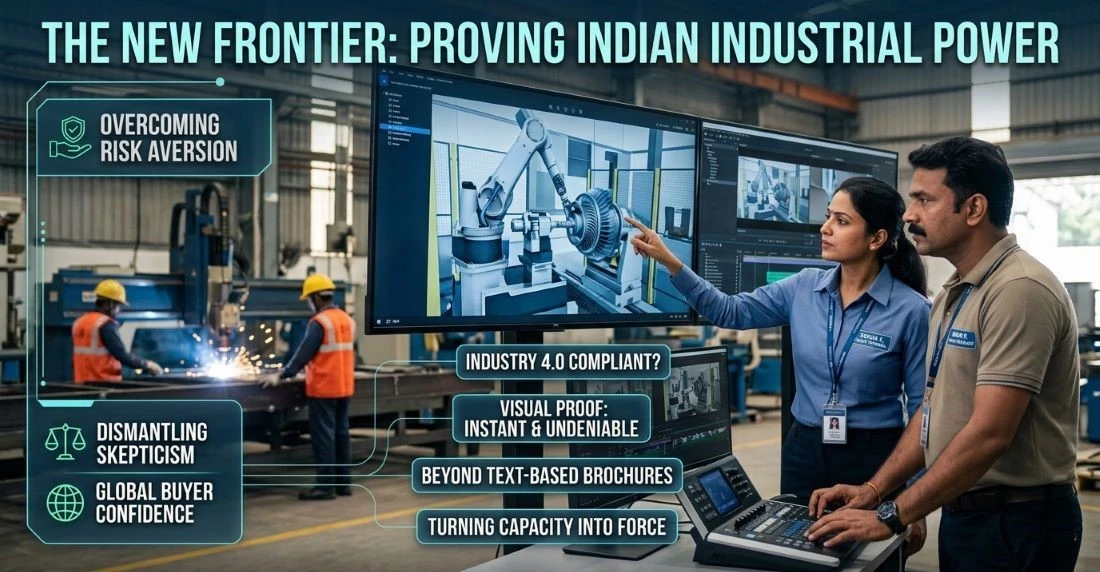
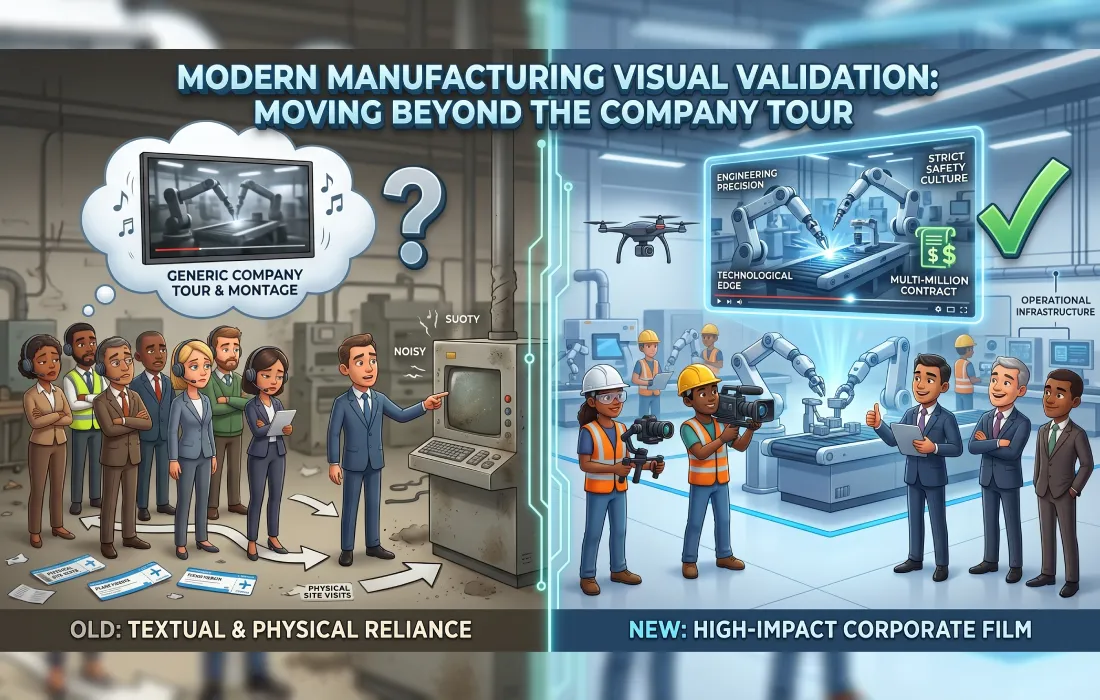
In the modern industrial landscape, a brand’s physical capability is only as powerful as its ability to communicate that capability to the world. Whether you are operating a massive heavy engineering plant, managing complex aviation ground handling operations, or deploying large-scale solar energy infrastructure, relying on outdated, text-heavy brochures or static PowerPoint presentations is no longer sufficient. Today’s global procurement managers, B2B buyers, and high-level investors demand undeniable visual proof of your scale, precision, and operational discipline.
According to Wyzowl’s State of Video Marketing Report, 89% of B2B buyers say a brand’s video has directly influenced their purchasing decision — making industrial video content one of the most powerful sales tools available to manufacturers and engineering firms today.
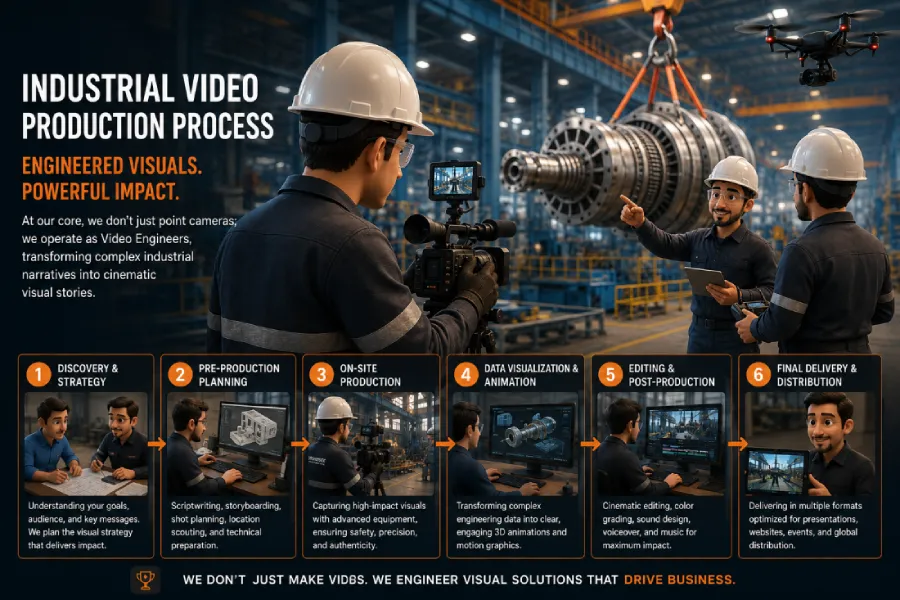
Industrial corporate video production is a 5-phase process covering pre-production planning, logistics, on-site filming, 3D animation integration, and multilingual delivery. Pixverse Media Pvt. Ltd., based in Ahmedabad, India, specializes in this end-to-end process for heavy engineering, manufacturing, and energy sector clients.
This shift has made corporate video creation for industrial organizations a fundamental requirement for market leadership. However, producing a video in a corporate office is vastly different from producing one on an active factory floor. Industrial environments are unforgiving, chaotic, and hazardous. Capturing the sheer magnitude of multi-ton machinery while communicating with a highly technical narrative requires a specialized approach.
At Pixverse Media Pvt. Ltd., we do not just point out cameras; we operate as Video Engineers. We specialize in transforming dense, complex mechanical data into cinematic, easily digestible visual narratives. Navigating this complex process requires strict discipline and a proven methodology. In this comprehensive guide, we will break down the exact industrial video production process we use to deliver world-class visual assets, from the initial concept to the final, hyper-realistic render.
Phase 1: Corporate Video Pre-Production – Engineering the Blueprint
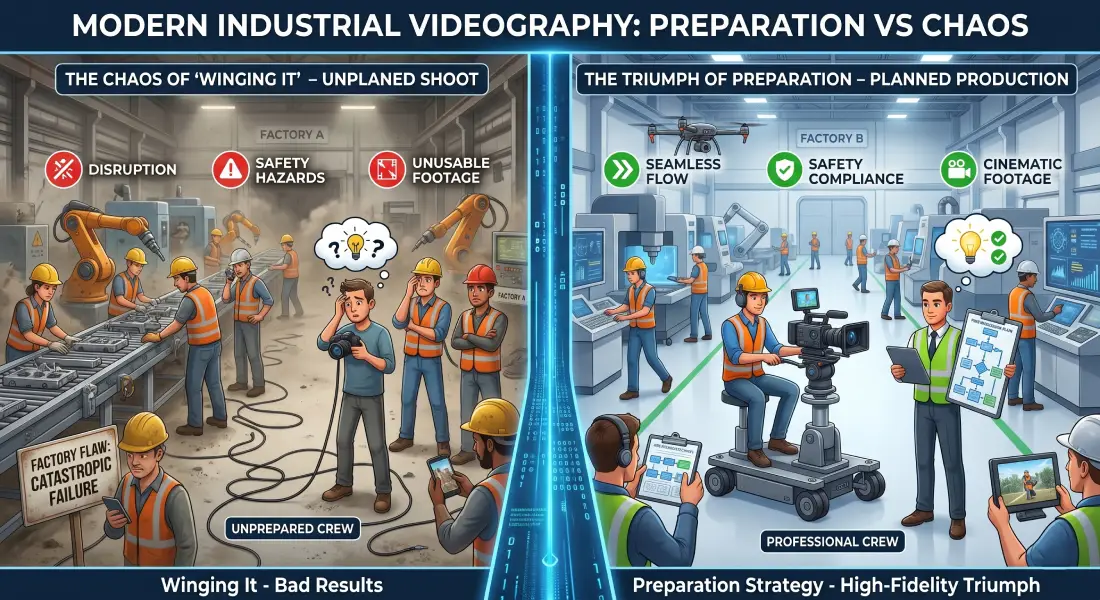
A successful industrial film is not found in the editing room; it is built during the planning phase. Skipping corporate video pre-production is a guaranteed path to missed objectives, budget overruns, and operational disruption.
Step 1: Objective Alignment and Audience Identification
Before a single camera is packed, you must define the precise goal of the video.
- Is this a factory capability video designed to win overseas B2B export contracts?
- Is it an internal safety induction video for new machine operators?
- Is it a high-level corporate documentary aimed at C-suite stakeholders?
Understanding the audience dictates the entire approach of your video project planning.
Step 2: Strategic Scriptwriting and Tone Calibration
Technical storytelling is an art form. The script must translate complex engineering jargon into a clear, compelling narrative. Crucially, the tone of the script must be meticulously calibrated to the target audience.
- For Frontline Workers: When developing safety scripts (such as 12-part safety training series for energy sectors), the language must be direct, authoritative, and unambiguous to ensure absolute compliance.
- For Corporate Executives: When the audience consists of high-level VIP clients or board members, the tone must pivot. Rather than delivering a demanding lecture, the script must be refined to be exceptionally polite, welcoming, and hospitable, gently guiding the executives through the facility’s value propositions.
Step 3: Storyboarding the Technical Narrative
In heavy industry, abstract concepts often need to be visualized. Storyboarding acts as a visual blueprint. We map out every scene, determining exactly when to use a sweeping live-action drone shot to establish scale, and when to transition into a 3D animated sequence to show the invisible internal mechanics of a machine. This step guarantees that all stakeholders agree on visual progression before filming begins.
Phase 2: Defining the Corporate Video Planning Steps and Logistics
Filming in a heavy manufacturing plant, an active airport tarmac, or a remote solar farm requires immense logistical preparation. The corporate video planning steps must account for the unique realities of industrial spaces.
Step 1: The Technical Site Visit (Location Scouting)
A specialized director must walk the facility well before the shoot date. During this scout, we are looking for:
- Visual Clutter: Identifying areas that need a 5S deep clean before the cameras arrive.
- Lighting Conditions: Industrial environments often feature mixed color temperatures (orange sodium lights mixing with blue daylight from bay doors), which can ruin the raw, hyper-realistic aesthetic required for premium corporate films. We plan our supplemental lighting strategy here.
- Acoustics: Heavy machinery creates deafening ambient noise, making on-site audio recording nearly impossible. We determine which segments will require professional off-screen voiceovers versus on-camera interviews.
Step 2: The Industrial Shoot Checklist
An industrial shoot checklist is far more rigorous than a standard corporate checklist. It must include:
- Clearance and Permits: Securing access to restricted zones.
- PPE Compliance: Ensuring every member of the film crew is equipped with the correct Personal Protective Equipment (hard hats, steel-toe boots, high-visibility vests) to mirror the facility’s safety culture.
- Production Schedule: Aligning the filming schedule with the factory’s operational shifts to capture the necessary machinery in action without disrupting critical production quotas.
Phase 3: The Industrial Filming Guide – Capturing the Shop Floor
Execution on the day of the shoot requires a crew that respects the hazards of the environment. The factory video production workflow is dictated by safety first, and cinematic capture second.
Step 1: Safety and Situational Awareness
Industrial film crews at Pixverse Media are trained in active-zone safety protocols, enabling seamless filming within live factory environments without disrupting production operations.
We maintain constant communication with the floor supervisors, never crossing safety barriers or interrupting active crane lifts. The goal is to act as an invisible observer, capturing the genuine authenticity of the workforce.
Step 2: Achieving Cinematic Realism in Harsh Environments
To capture the true essence of heavy engineering, we utilize cutting-edge 4K and 8K camera systems paired with prime cinema lenses. This equipment allows us to achieve a hyper-realistic, “raw photography” aesthetic.
- Dynamic Range: Capturing the intense, blinding sparks of a welding station while maintaining the dark, textural details of the surrounding machinery requires extreme dynamic range.
- Lighting the Impenetrable: We deploy specialized, high-output lighting to punch through the industrial haze, selectively highlighting precise textures, metallic reflections, and the exact physical features of the operators, ensuring a premium, polished look.
Step 3: Intentional Composition
Every frame must convey its purpose. An industrial filming guide demands that we compose shots to emphasize scale and precision. We use low-angle perspectives to make heavy stamping presses look monolithic, and extreme macro close-ups to showcase the microscopic tolerances of a finished component.

Phase 4: Post-Production & 3D Animation Integration
The raw footage captured on the factory floor is merely the raw material. The true magic of corporate film production happens in the post-production suite, where the narrative is actively engineered.
Step 1: Assembling the Narrative Arc
Our editors sift through terabytes of high-resolution footage, selecting only the takes that perfectly align with the storyboard. The pacing is crucial; we match the rhythm of the edits to the natural, pulsating tempo of the factory floor, driving the viewer engagement forward.
Step 2: The Power of 3D Industrial Animation
Live-action video has a distinct limitation: it cannot be seen through solid steel. This is where we integrate advanced 3D visualization. If your product features a complex internal fluid dynamic or a proprietary gear mechanism, we seamlessly transition from the live-action footage into a hyper-realistic 3D animated “X-ray” view. This allows the buyer to look directly into the heart of the machine. By blending real-world footage with precise, physically accurate CGI, we deliver absolute technical clarity that a standard video could never achieve.
Step 3: Color Grading for Brand Consistency
Color grading is where the raw footage is transformed into a cinematic masterpiece. We meticulously balance the colors to ensure the skin textures of the workforce look natural and consistent, while enhancing the warm, dramatic lighting of the industrial environment. The final grade aligns perfectly with your global corporate branding aesthetic.
Phase 5: Review, Refinement, and Final Delivery
The final phase of the industrial video production process is defined by rigorous quality control and iterative refinement. We understand that in technical industries, details matter profoundly.
Step 1: The Iterative Feedback Loop
We present the initial cut to your engineering and marketing teams. This is the stage where precision is finalized. If a digital avatar in an animated safety sequence requires a more consistent facial structure, or if a specific clothing item needs to be digitally altered to reflect updated safety gear (e.g., swapping a standard shirt for an arc-flash compliant suit), we execute those changes with surgical precision. We also conduct detailed artifact removal—ensuring that every frame is pristine, right down to remove a small, unwanted dot on a piece of safety glass or refining the digital body proportions of an animated character to match exact specifications.
Step 2: Multilingual Dubbing and Localization
To maximize the ROI of your investment on a global scale, we prepare the final video for international deployment. A single master video can be seamlessly dubbed into multiple languages (such as Hindi, Gujarati, Tamil, Marathi, or international languages like German and Arabic). Because our 3D animated sequences do not rely on human actors speaking to the camera, this localization process is flawless, completely bypassing the distracting “lip-flap” effect common in poorly dubbed live-action videos.
Step 3: Multi-Platform Delivery
Finally, we encode and deliver the video files optimized for their specific end-use. We provide uncompressed 4K master files for massive trade show displays, highly compressed versions for fast loading on your corporate website, and vertically cropped segments optimized for LinkedIn and social media campaigns.

Conclusion: Stop Telling, Start Showing
Mastering the process of corporate video creation for industrial organizations is not merely a marketing endeavor; it is the strategic engineering of your brand’s global authority. In a hyper-competitive marketplace, foreign buyers and high-level investors will not take your word for it—they demand to see the proof.
By adhering to a rigorous, step-by-step production workflow—from writing polite, highly calibrated executive scripts to capturing the raw, hyper-realistic essence of your factory floor, and seamlessly integrating advanced 3D technical animations—you replace buyer skepticism with undeniable confidence.
A masterfully produced industrial video serves as your untiring, “always-on” global sales engineer. It standardizes your pitch, clarifies your most complex engineering, and proves your operational discipline to the world. It is time to step out of the shadows of dense technical manuals and bring your capabilities into the light.