





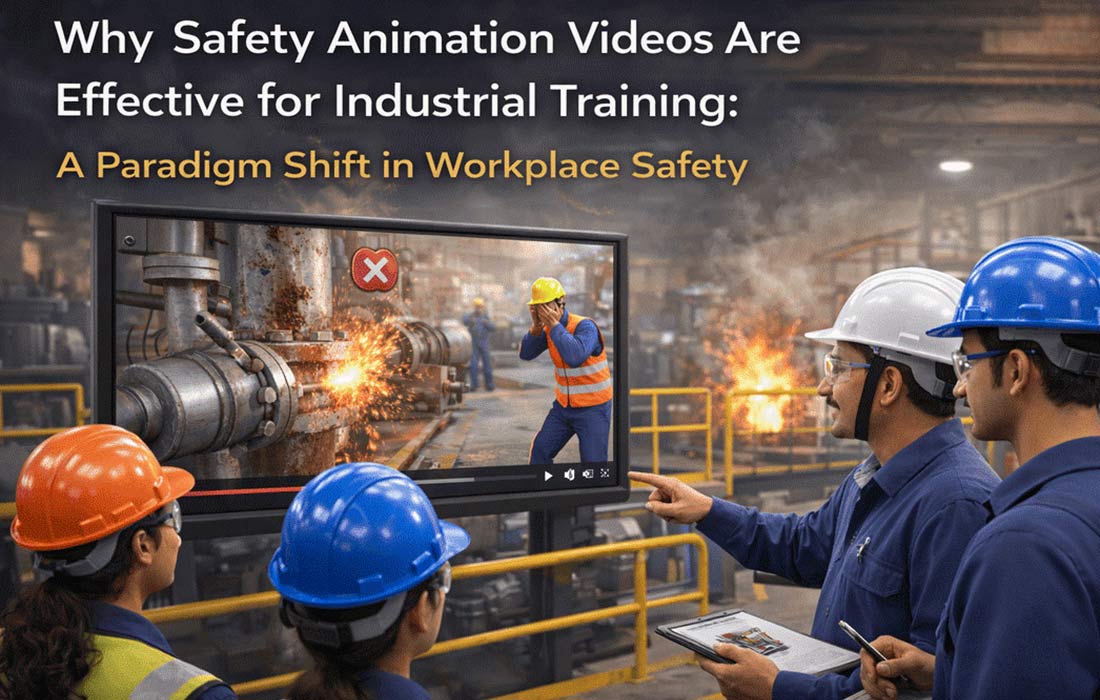
Why Safety Animation Videos Are Effective for Industrial Training: A Paradigm Shift in Workplace Safety
In the high-stakes environments of heavy manufacturing, oil and gas, construction, and chemical processing, safety is not merely a priority—it is a core value that dictates every operation. The ultimate goal for any plant manager or safety officer is a “zero-harm” workplace. However, achieving this requires ensuring that every single worker, regardless of their background or experience level, deeply understands complex safety protocols.
For decades, industrial training relied on traditional methods: thick standard operating procedure (SOP) manuals, monotonous classroom lectures, and static PowerPoint presentations. While well-intentioned, these methods are increasingly failing the modern workforce. They are often passive, unengaging, and struggle to communicate catastrophic risks effectively without putting anyone in actual danger.
This is where the industry is witnessing a significant transformation. Safety animation videos for industrial training have emerged as the most powerful tool to bridge the gap between theoretical safety knowledge and practical, life-saving application on the factory floor.
At Pixverse Media Pvt. Ltd., we have observed firsthand how transforming dry, technical safety data into dynamic animated safety training videos can revolutionize a company’s safety culture. In this comprehensive guide, we will explore why animation is so effective, the specific safety animation benefits, the types of videos essential for industry, and how our solutions secure your workforce.
What Is Industrial Safety Animation?
Before delving into the benefits, it is crucial to understand what industrial safety animation truly is. It is far more than just cartoons aimed at entertainment. It is a highly technical form of visual safety learning that utilizes 2D motion graphics or photorealistic 3D rendering to simulate industrial environments, machinery, complex processes, and potential hazards.
Unlike live-action video, which is limited by physical reality and safety constraints, animation can visualize the impossible. It can take a viewer inside a running engine to show a potential failure point, visualize invisible toxic gas clouds, or safely demonstrate the devastating consequences of ignoring a lockout/tagout procedure. It turns abstract concepts into concrete, understandable visual realities.
The Problem with Traditional Training Methods
To understand why factory safety animation is superior, we must first acknowledge the limitations of conventional training in today’s industrial landscape:
- The Engagement Crisis: Traditional lectures are passive. When workers are bored, they zone out, and critical life-saving information is missed. Low worker engagement directly translates to higher risk.
- The “Invisible Risk” Challenge: How do you effectively train someone on the dangers of stored energy in a hydraulic system or the long-term health impacts of chemical vapor inhalation using just text? It is nearly impossible to convey the severity of these invisible hazards through static media.
- Language and Literacy Barriers: Particularly in the context of workplace safety animation India, workforce diversity is a major factor. Employees may speak different regional languages or possess varying literacy levels. A text-heavy English manual fails to communicate uniformly to a diverse workforce, creating dangerous knowledge gaps.
Key Benefits of Safety Animation Videos for Industrial Training
Switching to animated video content addresses these traditional shortcomings directly. Based on industry research and our experience at Pixverse Media, here are the core benefits that make animation an indispensable tool for modern industry.
1. Boosts Retention and Reduces Human Error
The most significant advantage of animation is its ability to make information stick. Studies show that people retain approximately 85% more information when consuming video compared to reading text alone.
Animated safety training videos utilize dual coding—combining auditory and visual channels—to embed information into long-term memory. Whether it is a 3D animation illustrating complex machine operation or showing actual hazard zones, visual content ensures better recall. When a worker faces a critical situation on the floor, they are far more likely to remember a vivid visual demonstration than a paragraph from a manual, significantly reducing unsafe behaviors caused by misunderstandings.
2. Simplifies Complex Safety Procedures
Industrial machinery and protocols are inherently complicated. Professional safety video production transforms these complex, technical procedures into easy-to-understand visual content.
Instead of relying on inconsistent verbal explanations or confusing diagrams, safety animation provides clear, standardized demonstrations accessible to every worker, regardless of their education level or role. We can break down a 50-step shutdown procedure into a clear, step-by-step visual guide that leaves no room for ambiguity.
3. Educates a Multilingual Workforce Effectively
In diverse industrial hubs across India and globally, language barriers often severely affect the clarity of safety communication. Industrial safety animation transcends language.
While voiceovers can be easily dubbed into multiple languages (Hindi, Gujarati, Tamil, Telugu, etc.), the core visual message remains universal. A visual depiction of a worker donning the correct PPE or following a fire evacuation route is understood by everyone, ensuring that every team member comprehends the safety expectations regardless of their background.
4. Ensures Compliance with SOPs and Industry Standards
Regulatory bodies like OSHA, ISO, and BIS have stringent requirements for training documentation. Custom industrial safety videos built around your site’s specific SOPs help organizations meet these regulatory standards smoothly.
These videos serve as consistent, verifiable proof of training during internal and third-party audits, demonstrating a robust, standardized safety protocol is in place. This is animated compliance training at its most effective.
5. Streamlines Onboarding and Saves Time
Using pre-recorded contractor induction videos or standardized safety modules ensures that every new or temporary employee receives the exact same high-quality training without needing senior staff to repeat sessions constantly.
This saves valuable time for safety officers and speeds up the onboarding process, getting workers onto the floor faster without compromising on compliance or safety knowledge.
6. Strengthens Overall Workplace Safety Culture
Safety isn’t a one-time event; it’s a culture. Regular use of engaging safety awareness videos instills a strong safety mindset within your workforce. It promotes consistency, accountability, and continuous improvement, helping you create a workplace where safety is not just a policy written in a book, but a shared value practiced by everyone.

Types of Safety Animation Videos We Offer
At Pixverse Media, we understand that different hazards require different visual approaches. We offer a wide range of specialized animated video solutions tailored to industrial needs:
- Safety Induction Videos: The cornerstone of onboarding. These cover key site safety rules, emergency exits, PPE protocols, and basic do’s and don’ts for employees and contractors from day one.
- Fire Safety Training Videos: Combining 3D animation with real-location shoot elements, these videos educate on fire prevention, types of extinguishers, evacuation procedures, and emergency response scenarios.
- Machine & Electrical Safety Videos: Focuses on the safe operation of machinery, awareness of moving parts, high-voltage equipment protocols, and crucial Lockout/Tagout (LOTO) procedures to prevent severe injuries.
- Work At Height Safety Videos: Specialized animations highlighting fall prevention techniques, proper harness usage, anchor systems, and rescue operations for construction and infrastructure sites.
- Confined Space Entry Training Videos: These critical videos explain safe entry permits, atmospheric testing, ventilation, and emergency response protocols for dangerous environments like tanks, tunnels, and manholes.
- Chemical Handling Safety Videos: Demonstrates correct methods for storing, handling, and disposing of hazardous substances, including MSDS awareness, spill response, and specific PPE requirements for chemical plants.
Why Choose Pixverse Media for Your Safety Training?
Creating effective safety animation videos for industrial training requires more than just animation skills; it demands a deep understanding of industrial safety principles and engineering.
At Pixverse Media Pvt. Ltd., we combine creative expertise with technical accuracy. We work closely with your safety managers and subject matter experts to ensure every detail—from the specific model of a valve in a 3D render to the color codes of safety signage—is accurate.
With over 9+ years of experience, 700+ happy customers, and nearly 1200+ videos delivered, we have the proven track record to handle complex industrial requirements. We don’t just make videos; we build effective training tools that save lives and protect your bottom line.
Conclusion
Moving beyond outdated manuals and ineffective lectures is essential for modern industrial safety. Safety animation videos provide a proven, engaging, and highly effective method for communicating life-saving information across a diverse workforce.
By visualizing invisible hazards, simplifying complex procedures, and overcoming language barriers, animated video is the superior choice for ensuring workforce compliance and achieving that “zero-harm” goal.
If you are ready to upgrade your training program and build a stronger safety culture, invest in visual tools that actually work.

Ready to transform your safety training? Contact Pixverse Media today to discuss your specific safety challenges and let us create a custom animated solution for your workplace.