




Benefits of Multilingual Safety Animation for Industrial Workforces
The deafening roar of a heavy manufacturing plant does not care what language you speak, but when a critical alarm sounds, immediate comprehension is the difference between life and death. In the vast, interconnected industrial hubs of India and across the global supply chain, the workforce is a vibrant, highly dynamic mosaic of cultures and dialects. Migrant operators, specialized technicians, and international contractors frequently work shoulder-to-shoulder on the same shop floor, making traditional, single-language safety manuals a massive operational vulnerability.
When complex hazard protocols are delivered exclusively in English or a single dominant regional tongue, a significant portion of the workforce is left guessing. This glaring lack of language accessibility inevitably breeds operational confusion, shatters effective industrial safety communication, and drastically increases the likelihood of catastrophic workplace accidents. To genuinely secure a facility and protect human lives, modern heavy engineering firms must transition toward inclusive safety training that speaks directly and clearly to every single operator, regardless of their native background.
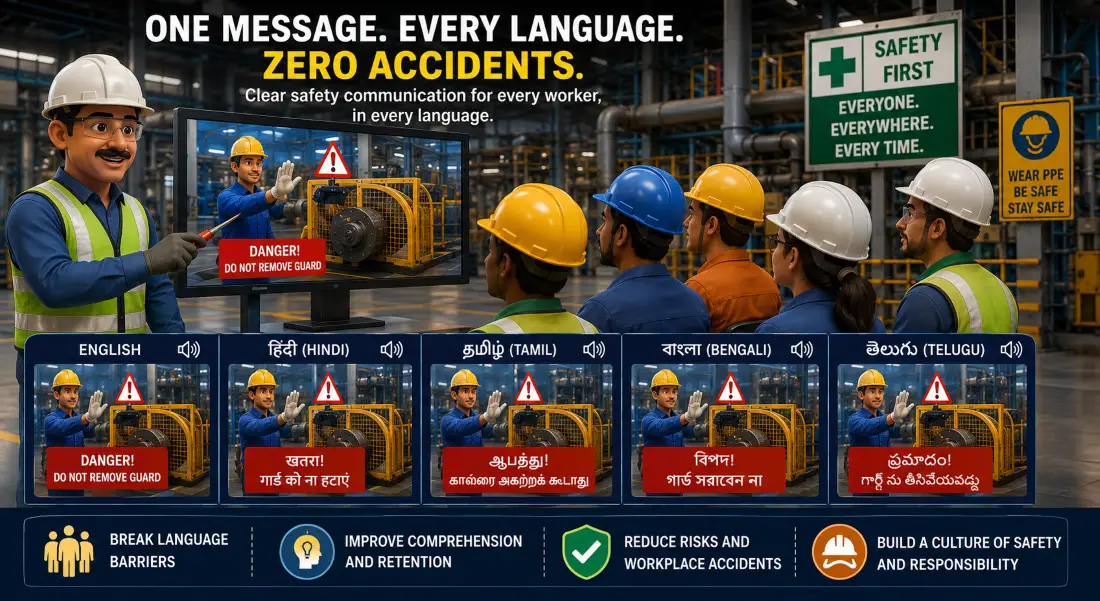
This is where the strategic deployment of a multilingual safety animation for industrial workforce environments becomes an absolute game-changer. By replacing dense, untranslatable text with hyper-realistic 3D visual storytelling paired with precise voiceover dubbing, organizations can bypass linguistic barriers entirely. At Pixverse Media Pvt. Ltd., we engineer visual infrastructure that guarantees 100% comprehension, transforming complex procedures into universally understood lifesavers and elevating factory worker safety videos India to world-class standards.
1. The Fatal Flaw of Monolingual Training in a Diverse Ecosystem
To understand the immense value of animated safety solutions, one must first recognize the failure of traditional methods. India’s manufacturing, construction, and aviation sectors rely heavily on immense workforce diversity. A massive factory in Gujarat may employ engineers who speak English and Gujarati, alongside hundreds of floor operators who speak Hindi, Tamil, Kannada, or Marathi.
The Illusion of “Good Enough” Comprehension
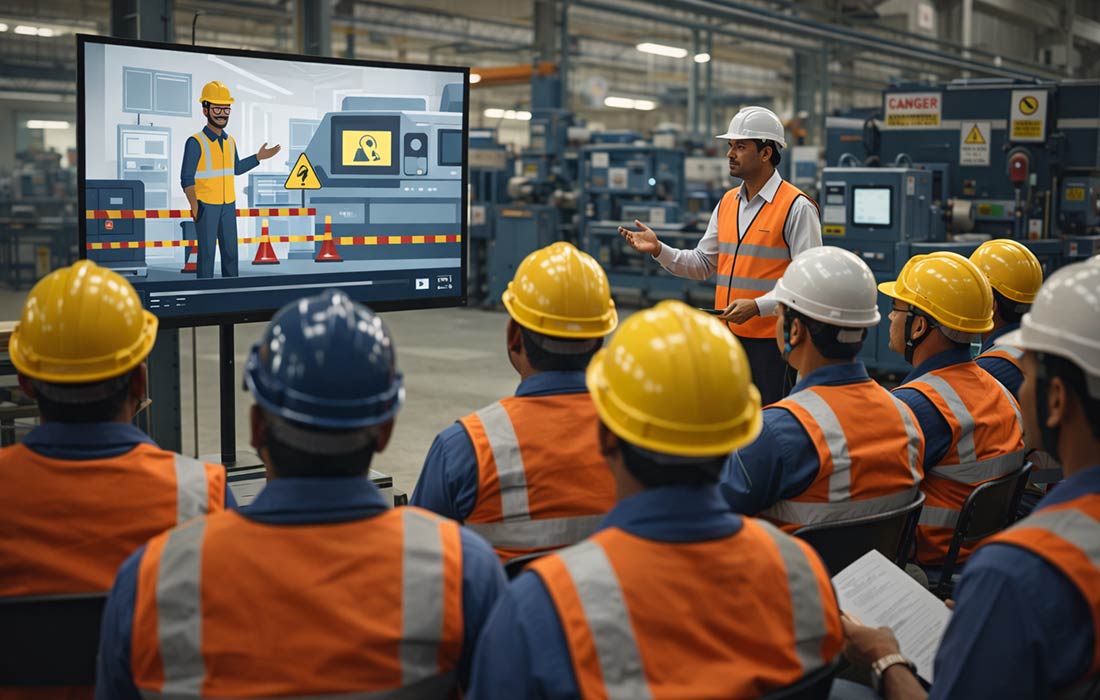
When an HSE (Health, Safety, and Environment) manager conducts a safety induction entirely in English or generic Hindi, they are often met with nodding heads. However, nodding does not equal technical comprehension. When a worker is attempting to decipher the second language being spoken to them, their brain is experiencing cognitive overload. They are spending so much mental energy simply translating the words that they fail to internalize the actual safety mechanism being taught. If an emergency occurs, that delayed processing time is fatal.
True inclusive safety training dictates that life-saving information must be delivered in the worker’s mother tongue. Hearing a critical safety procedure in one’s native language triggers immediate, instinctive understanding and fosters a much deeper emotional respect for the facility’s safety culture.
2. Why 3D Animation is the Ultimate Multilingual Tool
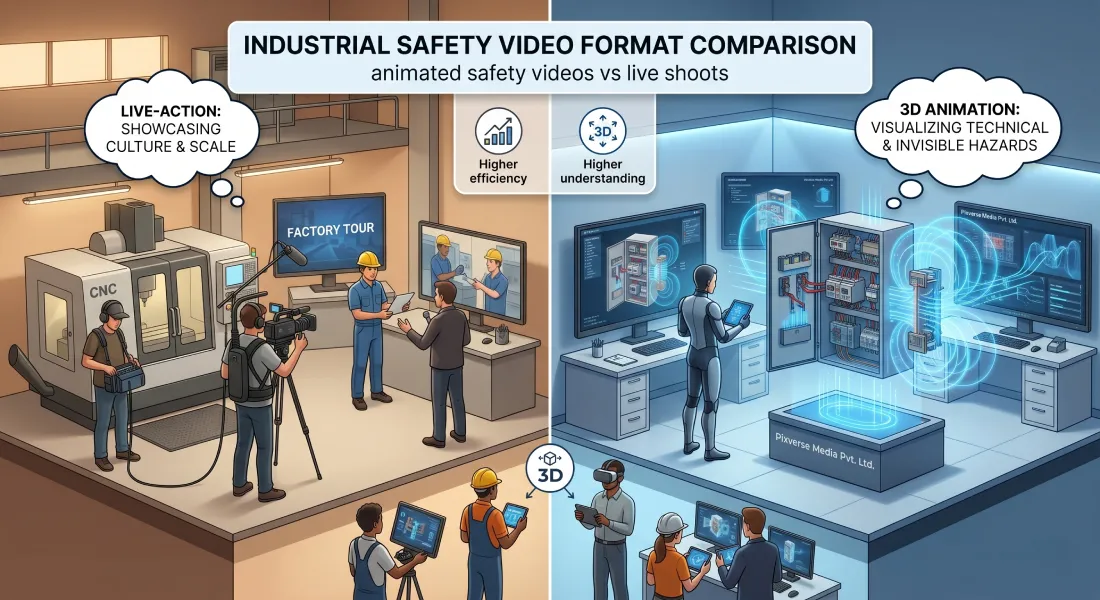
If translating safety content is the goal, why not just film a live-action video and dub it into different languages?
For anyone who has watched a poorly dubbed foreign film, the answer is obvious. When you take a live-action video of a safety manager speaking English and dub a Hindi or Tamil voiceover on top of it, the audio completely breaks sync with the speaker’s lips. This “lip-flap” effect is incredibly distracting. Instead of focusing on the safety procedure, the worker is distracted by the unnatural visual mismatch, severely degrading the quality of your industrial safety communication.
The Animation Advantage: Flawless Localization
Multilingual training videos utilizing 3D animation eliminate this problem entirely. Because high-end industrial animations rely on dynamic visual demonstrations (showing the internal mechanics of a machine, the proper sequence of a Lockout/Tagout procedure, or the dispersion of a chemical leak) paired with professional off-screen narration, there are no human lips to sync.
The visual—the universal truth of the procedure—remains perfectly intact. We simply swap the audio track. The exact same 3D visual of a robotic arm being safely de-energized can be flawlessly paired with specialized voiceovers, guaranteeing absolute technical clarity without any visual distraction.
3. Precision Across Regional Languages: Standardizing the Message
When a heavy engineering firm translates paper manuals, the tone, urgency, and technical accuracy often degrade across different translations. A severe warning in one language might be translated as a mild suggestion in another, leading to inconsistent compliance across the factory floor.
Achieving 100% Messaging Consistency

By utilizing safety training in regional languages via 3D animation, you lock in the visual standard. The visual demonstration of the safety rule becomes the immutable baseline. At Pixverse Media, we ensure that the localization process is exacting. When translating safety scripts from English into Hindi safety videos, or expanding them into Gujarati, Tamil, Kannada, and Marathi, the visual cues (like glowing red hazard zones or green checkmarks for correct PPE) ensure the core message remains universally identical.
Whether an operator is watching the Tamil version in Chennai or the Marathi version in Pune, they are receiving the exact same, standardized visual training. This absolute consistency is the bedrock of a zero-incident culture.
4. Contextual Nuance: Tailoring Tone for the Audience
A highly advantageous, yet often overlooked, benefit of digital animation is the ability to easily alter the tone of the communication for different audiences while utilizing the exact same visual assets.A heavy industrial facility does not just host blue-collar workers; it frequently hosts high-level corporate investors, VIP clients, and government regulators who require their own safety inductions before stepping onto the floor.
From Direct Commands to Polite Inductions
The tone required for a machinist operating a lethal stamping press is very different from the tone required for a visiting CEO.
- For the Floor Operator: The regional voiceover (e.g., in Hindi or Kannada) must be direct, urgent, and highly authoritative to ensure absolute compliance with heavy machinery protocols.
- For the Corporate Visitor: Using the exact same 3D animated walkthrough of the facility, we can record an alternate English voiceover tailored for VIPs. Instead of delivering an ordered, demanding lecture, the script is refined to be exceptionally polite, welcoming, and hospitable, gently guiding the executives through the “green zones” of the plant.
This duality allows a single animated visual asset to serve double duty, proving its versatility in comprehensive industrial safety communication.
5. Visualizing the Invisible to Support Language
Even the most perfectly translated voiceover can fail if the concept is too abstract. The ultimate benefit of a multilingual safety animation for industrial workforce applications is how the visuals aggressively support the spoken word.
The X-Ray Effect and Universal Symbols
If an audio track in Gujarati is explaining the dangers of an invisible toxic gas leak, the worker might still struggle to conceptualize the threat. However, when that audio is paired with a 3D animation that visually simulates the gas expanding across the room in a bright, neon color, the language barrier is completely shattered.
Animation relies on universal symbols. Blinking red lights for danger, X-ray cutaways showing the internal pressure of a boiler, and simulated, risk-free reconstructions of workplace accidents provide a visual context that makes the regional voiceover instantly understandable. It turns abstract safety theories into concrete visual memories.
6. The Long-Term Financial ROI of Scalable Training
Procurement managers and HSE directors are constantly evaluating the return on investment (ROI) for new safety initiatives. Creating separate live-action videos for every demographic within a massive industrial workforce is financially paralyzing.
The Economics of Digital Assets
3D animation is the most cost-effective solution for language accessibility at scale. The heavy lifting—the 3D modeling, lighting, rendering, and animating of your facility—is only done once. After the master visual file is created, versioning it out into different languages costs a fraction of the original budget. You are simply paying for the studio time to record new regional voiceover stems and layering them over the existing video.
Furthermore, if a safety protocol changes next year, you do not have to reshoot five different live-action videos. Our animators open the single digital project file, adjust the 3D model, update the relevant voiceover lines, and re-export the entire multilingual library. This infinite scalability ensures your visual infrastructure is highly adaptable and financially sound.

Conclusion: Securing the Future with Inclusive Communication
In the high-stakes environment of heavy industry, ignorance is the greatest hazard. When a facility relies on training materials that only a fraction of its workforce truly understands, it accepts a dangerous level of operational risk.
Investing in multilingual safety animation for industrial workforce environments is not merely an HR inclusivity initiative; it is a critical engineering safeguard. By combining the universal, hyper-realistic power of 3D visual storytelling with precise safety training in regional languages, organizations completely eradicate the ambiguity that causes accidents.
From direct, life-saving Hindi instructions for line operators to polite, welcoming English inductions for high-level corporate visitors, digital animation provides unparalleled flexibility and absolute messaging consistency. It is time to ensure that every individual who steps onto your facility floor is protected by training they instinctively understand.